Where to dive
Exploring SA Dive Sites
The 2025-26 harmful algal bloom reset our coastal ecosystems, but divers are observing incredible resilience and beauty on our reefs. As of autumn 2026, schools of fish are reappearing and there are new growths of sponges, tunicates and octocorals. Join SA Dive Sites Viz and Conditions for current observations of popular dive sites.
New divers becoming familiar with SA can easily check out our famous jetties and shore dives. Boat dives are available from several clubs and shops so you can explore the nearshore and outer reefs.
Warning: GPS coordinates are old and have not been verified.
Map of SA Dive Sites
For a detailed map of South Australia’s dive sites, go to DiveDB: https://divedb.net/ and click on Sites on the top menu bar.
DiveDB is a searchable database of dive sites across the State, crowdsourced from SA divers. Register to add or update locations of dive sites including GPS, photos, and details of accessibility, difficulty and other features.
Shore and Jetty dives
Metro area/Fleurieu
Marino rocks
Very shallow; accessible from the old boat ramp near the car park. Popular spot for fishers so watch for lines.
Hallet Cove
Access from the rocks at the far north end of the beach, swim round the point. Fish life varies on the reef; the dive can be just as interesting on the swim back to exit on the beach across from the cafe.
Port Noarlunga, South Australia
The Port Noarlunga reef system is extensive and offers excellent diving and snorkelling. The reef is broken into the Northern Northern and Southern sections that run parallel to the shore with depths of around 5m on the inside , 8m on the outside and around 10m in the gap between the reef sections. The Northern section and the gap is accessible from the platform at the end of the Port Noarlunga jetty. The Southern section is accessible via a snorkel of around 100m from the beach opposite. The reef abounds with numerous species of marine plants and animals. The Port Noarlunga Aquatic Trail with 12 markers starts next to seaward end of jetty and travels south along inside of reef through the gap and then north along the outside of the reef.
Christies Beach
Enter from the southern end of Christies Beach and swim out to a series of ledges. Port Jackson sharks aggregate here around November.
Star of Greece
This 125 year old wreck of a 3 masted iron ship build in Belfast in 1868 lies 200m off the beach at Port Willunga; it can be a shore dive or accessed by boat from O’Sullivan’s Beach boat ramp. It is popular for snorkelling as well as diving, when the area is free of swell and wind. Sand coverage of the wreck comes and goes with the weather conditions. Take in the reef as well which lies south of the wreck itself.
Star of Greece
This 125 year old wreck of a 3 masted iron ship build in Belfast in 1868 lies 200m off the beach at Port Willunga; it can be a shore dive or accessed by boat from O’Sullivan’s Beach boat ramp. It is popular for snorkelling as well as diving, when the area is free of swell and wind. Sand coverage of the wreck comes and goes with the weather conditions. Take in the reef as well which lies south of the wreck itself.
Gull Rock, South Australia
Gull Rock is a small island close to shore at the southern end of Maslin’s Beach. A reef extends out from the rock for several hundred metres. Access the reef from the beach south of Aldinga Reef or by boat from O’Sullivan’s Beach boat ramp. The reef extends from just below the surface to around 10m. GPS: 35:14:590 S/138:27:570 E
Myponga Beach, South Australia
A great shore dive with lots of crevices, walls and ledges. Most of the dive, there is a 4-5 metre vertical wall, with lots of drummer, Talma, old wives, goat fish and leatherjackets hanging around.
Carrickalinga reef
Navigate from the toilet block at the car park out to a shallow reef system.
Second Valley, South Australia
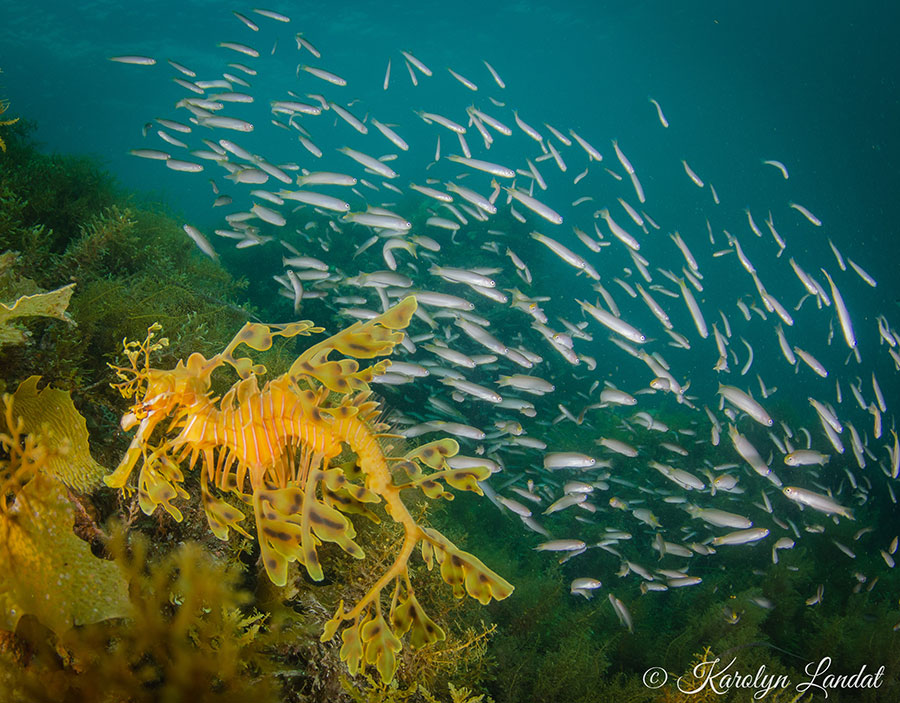
On the southern side of the jetty are 3 small bays. A shore dive, entry can be made either from the jetty stairs or by walking around to the second bay. South of this bay and cut into the cliff face are 3 small caves including a swim through with a right angle in it. Blue devils, leafy and weedy sea dragons and molluscs like Painted ladies are often seen.
Lassiter’s Reef
It is a 50m diameter dome shaped reef in 8m of water. There is a surprising variety of sea life and residents include the leafy sea dragon. Access is by a long swim from the beach at Second Valley.
Rapid Bay Jetty, South Australia
Rapid Bay Jetty currently has an exclusion zone around the entire old jetty due to its instability. Divers can still enjoy the waters outside of the exclusion zone using the new jetty’s purpose-built stairs and platform. The underwater routes to the old jetty and T-section are marked by star droppers; do not follow into the exclusion zone. The area is mainly famous for a resident population of Leafy Sea Dragons which, although cryptic, can be found with perseverance (or take a tour with a guide from one of the dive shops). When viewing or photographing these, we ask that you maintain your distance and resist the urge to touch them.
The Blowhole, South Australia
This site is in Deep Creek Conservation Park 80 kms south of Adelaide and is only accessible by four wheel drive. You need to follow the signs through the park, down the dirt road to the car park. Four wheel drive only from the carpark down a very steep track to the end. Follow the steep walk/path several hundred metres to a small beach. Entry is anywhere from the beach. This is a beautiful unspoilt site. It is teeming with life, crays galore, seals and sea dragons. You do have to watch for heavy current and freak waves and its strongly advised you dive with someone who knows the area.
Fisheries Beach, South Australia
The beach is east of Cape Jervis. A shore dive, to the right of the sandy beach is a line of rocks that goes out 50 metres into the water. Directly out from that is a reef 3-400 metres offshore, that runs parallel to the shore. The reef isn’t overly high, but there is a quite a bit of life on it. Around the reef, and between the reef and shore, are heaps of anchors, cart wheels chain, etc. that are almost 100 years old.
The Bluff, Victor Harbour
The Bluff at Victor Harbour is awesome in good conditions. Entry is from the small wharf on the eastern side of the Bluff. Leafy sea dragons are often seen here. There are also seals, seahorses, weedy sea dragons, crayfish, nudibranchs, plus lots and lots of fish. The area is strewn with big granite boulders, stacked one on top of the other, with big holes, ledges, swim throughs, etc. In the holes are a big variety of sponge, and soft coral life, as well as the occasional nudibranch. Depth ranges from 4m to 40m.
Whale Bones, South Australia
Whale bones is in Encounter Bay at Victor Harbour. Follow the road to the bluff and turn off at the hospital. Whale bones is the reef in front of and to the right where this road meets the beach. Access is from shore over a 100 or so metres of knee deep water or by boat from the nearby Bluff boat ramp. This is a big system of limestone caves, undercuts, swim-throughs, and reef. It is a virtual honeycomb of caves, and passages. The top of the reef is only in about 2-3 metres of water, with lots of holes in the top, that lead down into the caves. If you head out to sea, you will also see a drop-off, which also leads into the caves. The site got its name from the fact that there used to be lots of whale bones in the area, as the whalers used to dump the whale carcasses in the area.
Yorke Peninsula
Ardrossan Jetty, South Australia
An easy shallow shore dive to 6m good for beginners.
Wool Bay Jetty, South Australia
A very shallow dive to around 4 metres but the home of many leafy seadragons.
Edithburgh Jetty, South Australia
One of the best jetty dives in the State and a popular night dive with substantial marine diversity. Lots of nudibranchs and seahorses under the jetty. The pylons are covered with sponges. Usually there are heaps of fish life, cuttlefish, squid, octopus and dumpling squid. Port Jackson and small cat sharks are sometimes seen. 50 metres out from the north side of the jetty, there is also a reef, with lots of life on it too.
And a tip from Steve Simmons about how to judge whether conditions are good for diving at Edithburgh: If wind is N NE or E even though they maybe light winds vis will usually be poor. N = average to poor; NE = poor; E = atrocious; SE = generally ok; S = Good to Great Sw; W = Really good; NW = usually OK.
Point Turton Jetty, South Australia
Whilst the jetty is shallow at 5m, there is a lot of life on the pylons and nudibranchs and blue ring octopus are often found here.
Port Giles Jetty, South Australia
This is a long, working grain loading jetty. We’ve received word that diving, fishing and snorkelling have been banned from the jetty itself by the owners regardless of whether there is a ship at the jetty or not. In the past, shore diving access has been possible from the steps at the beginning of the jetty, or as a boat dive launching from Edithburgh boat ramp. There is lots of life under the jetty with the pylons covered in sponges and soft corals. There is a big eel bed, with lots of eels there. It’s quite deep for a jetty, getting up to around 14 metres at the tank at the end of the jetty.
Port Hughes Jetty, South Australia
Fish life is prolific, including large numbers of Cowfish. There are nudibranchs galore and this is a macro photographers paradise, with the chance of spotting seahorses amongst the abundant and colourful growth on the pylons or on the Sargassum algae on the periphery. Access is easy, with plentiful parking close to the jetty and toilets with a (cold water) shower. It is a shallow dive (5m), allowing plenty of time to cruise to the end and back.
Port Victoria Jetty
A very pretty dive, if a short one. See also Wardang Island under boat dives for the historic shipwrecks off Port Victoria.
Stenhouse Bay Jetty, South Australia
This is a lovely jetty dive in 10m with shore or boat access. Boats can be launched from Marion Bay boat ramp. There is amazing life on the numerous pylons of this old wooden jetty. At the end of the jetty is a Ford Telstar upside down.
Eyre Peninsula
Consult DiveDB and Whyalla Dive Shop and The Dive Shop, Port Lincoln for guidance on local sites.
Whyalla: Giant Cuttlefish Aggregation
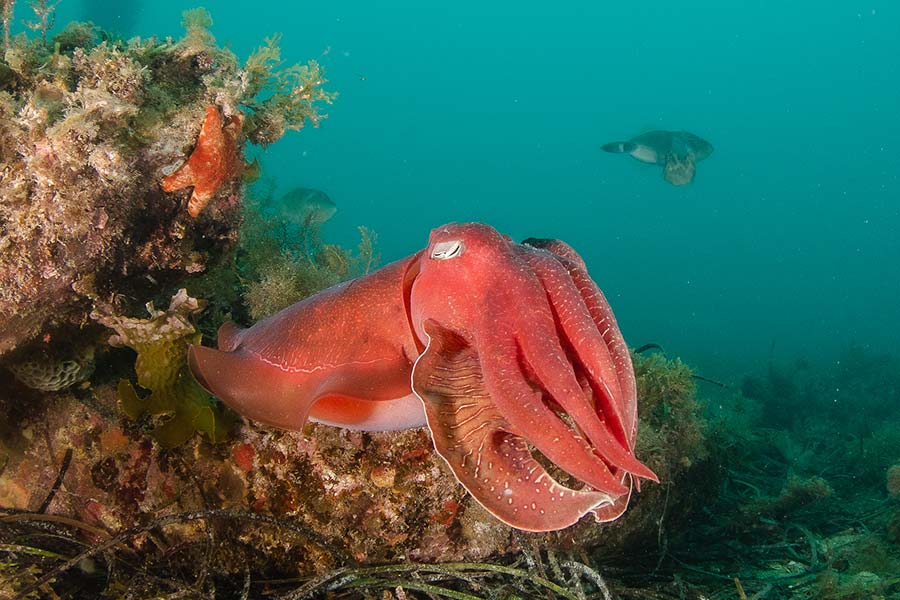
The Giant Australian Cuttlefish migrates each year to the Upper Spencer Gulf breeding grounds near Point Lowly, South Australia, during the months of May through to early August. This is a globally unique mass aggregation event, recognized internationally by David Attenborough’s Blue Planet and others. The site is in shallow waters suitable for snorkelling as well as scuba. Accommodation and services, including tank fills and gear hire, are available in the nearby community of Whyalla. See SDFSA’s Services Directory for shops in the region.
Tumby Bay jetty
Leafy seadragons, seahorses, marine life encrusted pylons
Boat dives
Warning: GPS coordinates are old and have not been verified.
Metro Adelaide waters
Broken Bottom, South Australia
Broken bottom is part of the old shore line and consists of a series of naturally formed rock piles spread over a large area 2kms north west of Glenelg in 10m of water. Access is by boat from the West Beach boat ramp. Fish life is sparse to prolific with no set pattern. If fish life is sparse you can investigate the rock piles, sea tulips and razor shells. At other times the whole dive can be taken up swimming amongst schools of Old wives, Bullseyes and the occasional Yellowfin whiting. Many Spider Crabs inhabit this area and occasional Rays and Flatheads may be found.
GPS: 34:57:773 S/138:28:822 E
Claris, South Australia
28m shipwreck about 4km west of the Dredge around 12m in length
GPS: 35:00:250 S/138:21:089 E
MV Andrew Wilson, South Australia
The 40-metre grab hopper dredger is the first vessel to be scuttled in South Australian waters in more than two decades.
SDFSA has been proud to be a part of the project team to make this happen.
Resting upright at a maximum depth of 20 metres, with a draught of 16 metres, the site is suitable for anyone with an entry-level scuba diving qualification. The vessel is situated approx. 6 kilometres west of Seacliff Reef.
GPS Coordinates are: 35o 01.4039327 S 138o 26.8532505 E
Glenelg Barge, South Australia
The Glenelg Barge is a hopper barge used by the South Australian (Glenelg Dredge) to take the silt dredged up from the Port River and dump it further out to sea. She was sunk in 1984 as an artificial reef and lies in 20m of water. Access is by boat from the West Beach boat ramp. A star dropper trail has been set up to enable divers to travel from the barge to the South Australian dredge in times of low current. The barge is a very interesting wreck with a wide variety of fish. Divers can swim its 30m length with ease. At either end there is a small opening where divers can penetrate into the work rooms. Divers can now access the workrooms from inside the hoppers as the bulkheads have rusted away in some areas. In these rooms on each side of the hoppers is the entrance to the flotation chambers and divers may peer into them. Divers may be tempted to attempt a penetration and it can be done as long as the divers are properly prepared with lines, torches etc. The entrance to each chamber is very restricted. This penetration is not recommended. The main hazards are rusting metal, silting and restricted entrances to the penetrations.
GPS: 34:58:729 S/138:26:462 E
The Dredge: SS South Australian
The 133 foot South Australian, commonly known as the Dredge, was built in Holland in 1911 and sailed to Adelaide arriving in 1912. The vessel was a self propelled cutter suction dredge that was used to dredge the Port river. The South Australian ceased its working life in 1982 and was scuttled in January 1985 as a recreational resource for divers and anglers. Access is by boat from West Beach boat ramp. The wreck is laying upright in 20m water with the deck area in about 15m. The site has prolific fish life and is arguably the best fish dive off the metropolitan coast. A star dropper trail has been set up to enable divers to travel from the dredge to the barge in times of low current.
GPS: 34:58:667 S/138:26:441 E
Glenelg Tyre Reef, South Australia
The Glenelg tyre reef is a series of tyre tetrahedrons, set down as an artificial reef. Set up in 1983, 5kms west of Glenelg, 500m south east of the barge in 18m of water. As a fish breeding ground it has been very successful with large quantities of Whiting, Bullseyes, Strongies, Silver drummer, Old wives and Spider crabs. The main hazard is getting loose regs and gauges caught in tyre straps. The site has deteriorated somewhat: many of the tetrahedrons have come apart and areas of the reef scattered.
GPS: 34:58:903 S/138:26:605 E
Grange Tyre Reef, South Australia
Man-made reef approx. 4kms offshore from West Beach. Access is by boat from the West Beach boat ramp. Made up of a series of squares of old tyres laid down by the Fisheries Dept in the late 70s. The tyres lie in 15m of water and over the years the squares have split up and spread over a large area. The dive is interesting with a wide variety of life. Weedy seadragons can occasionally be seen here.
GPS: 34:54:895 S/138:24:062 E
John Robb, South Australia
The John Robb was built in Port Adelaide in 1879 and sank during a storm around 1910 and is in the outer shipping channel to Outer Harbour, The wreck is 15kms offshore from North Haven and lies in 18m of water. Access is by boat from the North Haven boat ramp. The wreck is now nearly completely broken up with only the bow section recognisable sticking out of the sand pointing west. The wreck is extremely difficult to locate as land marks are almost impossible to find and a reliable GPS bearing is needed. Marine life around the wreck varies from prolific to almost barren depending on the day. Visibility is generally fairly good due to the distance offshore, but it is subject to tidal currents which can be strong.
GPS: 34:49:360 S/ 138:20:260 E
Leather Jacket Alley, South Australia
Leather Jacket Alley is approximately 2kms North west of Glenelg and is in 10m of water. Access is by boat from the West Beach boat ramp. The dive site consists of a series of naturally formed gutters inhabited by a wide variety of fish and aquatic flora — notable for its wide variety of Leather jackets, including the elusive Pygmy leather jacket.
GPS: 34:58:163 S/138:28:832 E
Lumb, South Australia
The Lumb was sunk in 1994 specifically as a dive site by the SA dive industry. She lies upright on the bottom 50m west of the Noarlunga tyre reef in 20m of water 2.5 kms west of Noarlunga jetty. Access is by boat from O’Sullivan’s Beach boat ramp. The Lumb started life as a tug working in Tasmania before being used at Port Lincoln. She was refitted as a fishing trawler and used to fish for tuna. At the end of her life she was purchased by the dive industry. She was cleaned up and holes were cut in her deck and she was sunk as a dive site. Penetrations are easy and safe as holes were cut allowing easy safe penetration. Fish life can be sparse to prolific and look out for the many nudibranchs on the wreck.
GPS: 35:08:881 S/138:26:530 E
Mac’s Ground, South Australia
Mac’s Ground is a small reef 4.5kms west of Glenelg in 17m of water. Access is by boat from the West Beach boat ramp. It is part of the old shore line and is a reef approx 1m high lying in an east west direction. The reef is about 150m long and has numerous overhangs and a small cave, home to squid and Cuttlefish. Other species of fish include Blue devils, Silver drummer, Strongies, Bullseyes, Old wives, Leather jackets and Spider crabs. It s a favoured fishing ground for winter Whiting. The fish life is usually prolific and tame which makes a great dive. There are no hazards.
GPS: 34:58:550 S/138:27:084 E
Milkie’s Reef, South Australia
Named after the finder who was a milkman, Milkies is a reef running north south 4.5kms south west of Glenelg in 17m of water. Access is by boat from the West Beach boat ramp. Spider crabs abound and there are numerous nudibranchs, Blue devils, Cuttlefish, Strongies, Silver drummer and the occasional crayfish. At times it is the best local dive around because of the variety of fish life. Very few divers visit this area. There are no hazards except tidal currents.
GPS: 34:59:189 S/138:27:241 E
Noarlunga Tyre Reef, South Australia
Lying in approx. 20m this set of tyre pyramids is spread out over a wide area off Port Noarlunga. There are lots of little fish to be seen, and it also acts as a haven for Boarfish, Cowfish, Octopuses, Blue devils, Morwongs, Wobbegongs. Bullseyes and Perch. The pyramids look very similar so divers can become disorientated.
Norma, South Australia
The NORMA was a steel 4 masted iron barque of 2122 tons, measuring 278 feet, that sank in the main shipping channel of Outer Harbour in 1907 when it was rammed whilst at anchor by the Ardencraig. The day after the sinking the Jessie Darling ran over the wreck and sank on top of the Norma breaking her back. The Jessie Darling was subsequently refloated. Because of the danger to shipping, the Norma was dynamited. The wreck lies about 5kms offshore from North Haven in 14m of water and is subject to strong tidal currents. Access is by boat from North Haven boat ramp. The wreck of the Norma is spread out over quite a large area and consists of a large area of twisted metal lying on the bottom. The bow area is still recognisable and acts as a marine haven for fish. The remains are very interesting, The fish life is prolific with wobbegongs frequently seen. If diving the Norma be aware it is still in the shipping channel and it is unwise to leave your dive vessel without surface support as large ships still use the channel. A marker bouy is positioned about 25m due west of the wreck.
GPS: 34:49:349 S/138:25:111 E
Seacliff Reef, South Australia
To many a diver, this site is the best local site due to the abundance of fish and its relatively shallow depth. Seacliff reef is part of the old shore line from about 10,000 years ago. It is a reef approximately 1 metre high. It travels in a north/south direction and is home to literally thousands of fish, including a number of large Blue devils. A whole dive can easily be taken up by sitting on the bottom watching the fish and not moving more than a few metres. The depth of the reef varies from 12m to15m without any hazards. Access is by boat from either West Beach or O’Sullivan’s Beach boat ramp.
GPS: 35:02:264 S/138:29:440 E
MV Seawolf, South Australia
The boat, originally named the Matsu Maru , was owned by a tuna fisherman from Port Lincoln who had obtained the boat from the Australian Government after it was confiscated while operating off Darwin. The owner planned to refurbish it for the lucrative tuna long line fishing industry, however, as tuna farming was gaining momentum at the time it became uneconomic to refurbish the boat to Australian standards to enter the declining long line industry. The partially stripped hull lay unused from 1993, anchored off Lincoln Cove Marina and became something of a local eyesore and haven for multitudes of feral pigeons.
After negotiations by Christopher Deane, and fundraising (quite modest, compared to more recent sinkings) by the Sea Wolves Dive Club and the rest of the SA Dive Community, the hulk was towed to Port Adelaide from Port Lincoln on 20/21 October 2001 so that the extensive cleanup and preparation for scuttling could be done safely and efficiently. The man-made contaminants were nothing compared to all of the guano which had to be removed before it could be sunk!
With her new name emblazoned across her stern and bow, on Saturday March 23, 2002 she was scuttled and lies on her starboard side some 20 metres slightly to the south east of the hull of the HA Lumb, making the site a two wreck dive with a tyre reef thrown in for added interest!
GPS location is 35 deg 08.879 min S, 138 deg 26.525min E using the WGS 84 datum. Look for the “bomb” on deck and other Sea Wolves markers below decks.
Stanvac Barges, South Australia
There are 3 barges at this site that were sunk in 1954, one is 50m x 9m and the other two measure approximately 20m x 9m. At 28m this is an advanced dive and bottom time is restricted. The barges form an artificial reef with plenty of fish life and lie approximately 5kms west of Port Stanvac and rest on an otherwise sandy bottom. Access is by boat from O’Sullivan’s Beach boat ramp.
GPS 35:06:908 S/138:24:656 E
The Blocks, South Australia
The Blocks is a series of cement blocks visible at low tide and located 1/2 a kilometre from shore in 6m of water. The blocks were used as a mooring system for early ships coming to Adelaide. Access is by boat from West Beach boat ramp. On a good vis day, this is an interesting second dive, especially if you have plenty of air left after your first dive and just want to use the same cylinder. It is an easy dive with plenty of area to cover. This is an excellent muck dive. Wobbegongs have been found here.
Fleurieu region
Aldinga Drop Off, South Australia
The Aldinga Drop Off is on the edge of the Aldinga reef lying 1.5 kms off the Aldinga beach. Access is via boat which can be launched from the Southern end of Aldinga Beach or from O’Sullivan’s Beach ramp. The reef drops away from 5m to 21m creating a spectacular dive that is a mass of caverns, crevasses and overhangs. The reef is inside an aquatic reserve and fish abound making this a photographers paradise. The Drop Off is where the big schools of snapper stay when travelling north to their breeding grounds. When the snapper are running it is advisable not to dive this area as the snapper school is occasionally followed by white pointer sharks.
GPS: 36:16:270 S/ 138:25:799 E
Aldinga Pinnacles, South Australia
Part of the Aldinga reef system closer in shore from the drop off. Spectacular dive with lots of swim throughs, overhangs, fish life and weed growth. The dive is in only 8m of water so an extended amount of time can be spent exploring the reef system, the overhangs and occasional cave. Visibility here is generally very good and swimming amongst rock pinnacles extending from the sea floor to just beneath the surface of the sea is very different to other SA dives.
GPS: 35:16:010 S/138:26:020 E
ExHMAS Hobart, South Australia
The ex HMAS Hobart was a Charles F. Adams class guided missile destroyer in the Royal Australia Navy (DDG 39), built in the United States of America and commissioned in 1965 in Boston. The vessel completed three tours of duty off Vietnam and in 1968, two sailors lost their lives and seven others were injured after the vessel was hit by “friendly” fire. The Hobart was sunk in November 2002 as an artificial reef and lies in 30 metres of water approximately 4 kms off Rapid Bay. Access is by boat from Sunset Cove boat ramp. Permits must be obtained to dive the Hobart: https://www.environment.sa.gov.au/marineparks/enjoy/diving/diving-the-hmas-hobart. The 134m wreck which takes several visits to see it all caters for all levels of diving experience.
Rapid Head, South Australia
An interesting dive site, with a vertical wall, from the bottom which varies from 6-8m deep and usually an abundance of fish life. Access is by boat from Sunset Cove boat ramp. There is a fairly low rocky reef system, that heads out to sea from the wall.
Black’s Reef, South Australia
Black’s reef is between the Bluff and Wright Island in Encounter Bay at Victor Harbour. It is quite a swim if done as a shore dive. Alternatively access is by boat from the Bluff boat ramp. There is an extensive reef system with depths to 14m.
Yorke Peninsula
Althorpe Island, South Australia
With depths to 40m there are more than 50 great dive sites around the Island, with lots of different things to look at. There are 20metre + walls, reefs, 3 wrecks, a couple of seal colonies, Lots of crayfish, and abalone (in season). Most dives, you will see seals, there are always big blue grouper, as well as schools of other fish.
Ardrossan – BHP Jetty, South Australia
Because of the length of the jetty it is best done by boat launching from Ardrossan boat ramp. Huge schools of fish congregate at the end in a depth of around 15m.
Haystack Island, South Australia
There is a reef approximately 500 metres off the shore of the Island, running parallel to it. It is a big wall, running the length of the island (more than a kilometre) with the sand at 22 metres, and the wall going up to about 10 metres in some spots. There are caves everywhere, swim-throughs, chasms and gorges. The wall is so long, you can easily do many dives there all in different spots. There are crayfish in abundance. The sponge and soft coral life has to be seen to be believed, it is so colourful, red, yellow, and orange everywhere. But probably the best thing about this wall, is the abundance of fish.
Troubridge Point, South Australia
This can be dived either from shore or by boat. Access to the best areas is by boat launched from Edithburg boat ramp. It is a large reef system that covers a couple of kilometres of shoreline, with huge swim through, bommies, chasms, pinnacles. Depths range to 20m. Fish life is amazing and crayfish plentiful but cannot be taken inside the section of reef inside the reserve.
SS Australian, South Australia
The SS Australian was a 49m 352 ton vessel that sank on the Southern end of Wardang Island 8 May 1912. The stern of the wreck lies in 8m of water with wreckage extending up the reef to a depth of 2.5m. The bow section has broken off and is about 100m North East of the wreck in shallow water. Fish life is usually prolific.
GPS: 34:32:052S/ 137:21:874E
SS Investigator, South Australia
The SS Investigator was a 64m 605 ton vessel that sank on the Western side of Wardang Island 24 April 1918. The wreck lies in 3m to 4m of water. Fish life is usually prolific and the ship’s anchor and propeller can be seen.
GPS: 34:31:600S/137:20:060E
SS MacIntyre, South Australia
The SS MacIntyre was a 33m converted river barge of 127 tons that sank near the SS Australian 1 April 1927 at the Southern end of Wardang Island. The wreck lies in 4m to 8m of water. Fish life is sparse compared to the SS Australian.
GPS: 34:32:080 S/137:21:980E
Songvaar, South Australia
The Songvaar was an 85m iron ship of 2128 tons that sank on 14 April 1912, the same day as the Titanic. The Songvaar was loaded and ready to sail and sat on her anchor as the tide went out and sank herself. Because of the danger to shipping in the area the wreck was subsequently blasted. The offending anchor can still be seen piercing the hull. The fish life on the wreck lying in 9m is amazing.
GPS: 34:27:567 S/137:23:277E
Wedge Island, South Australia
Wedge is the largest of the islands accessible by boat from Pondalowie Bay. With depths to 50m there are lots of walls, drifts, swim throughs and caves. Fish life is prolific.
Willyama, South Australia
The Willyama was a 2705tonne steamer, built in 1897. On the night of 13 April, 1907, she ran aground at Rhino’s Head Marion Bay. There is quite a bit left of her, with one of her masts standing a couple of metres out of the water. What is left is fairly broken up and scattered around the bottom. Reaching 12m in depth the wreck is abundant with fish life.
Zanoni, South Australia
The Zanoni cannot be dived without a permit issued by Heritage SA. A boat mooring buoy has been installed at the site for the safety of divers and so the wreck will not suffer anchor damage. It is illegal to damage or interfere with the wreck and penalties are severe, and may involve substantial fines, imprisonment and/or confiscation of equipment. The wreck is a marine reserve, so no fishing or taking anything from it.
Built in 1865, and sunk in 1867. Approximately 15 nautical miles from Ardrossan. She was a 3 masted composite ship, 42 metres long. A remarkably intact wreck, for her age. She lies on her side, and a bit of the superstructure is still standing.
GPS: 34:30:707 S/138:03:823 E
Eyre Peninsula
Consult DiveDB and Whyalla Dive Shop and The Dive Shop, Port Lincoln for information on boat tours into marine parks and other areas.
Shark Cage Diving, Port Lincoln
Tour operators based in Port Lincoln provide day trips and liveaboard experiences to the Neptune Islands to view Great White Sharks. Consult the SDFSA Services Directory for the Port Lincoln tour operators.